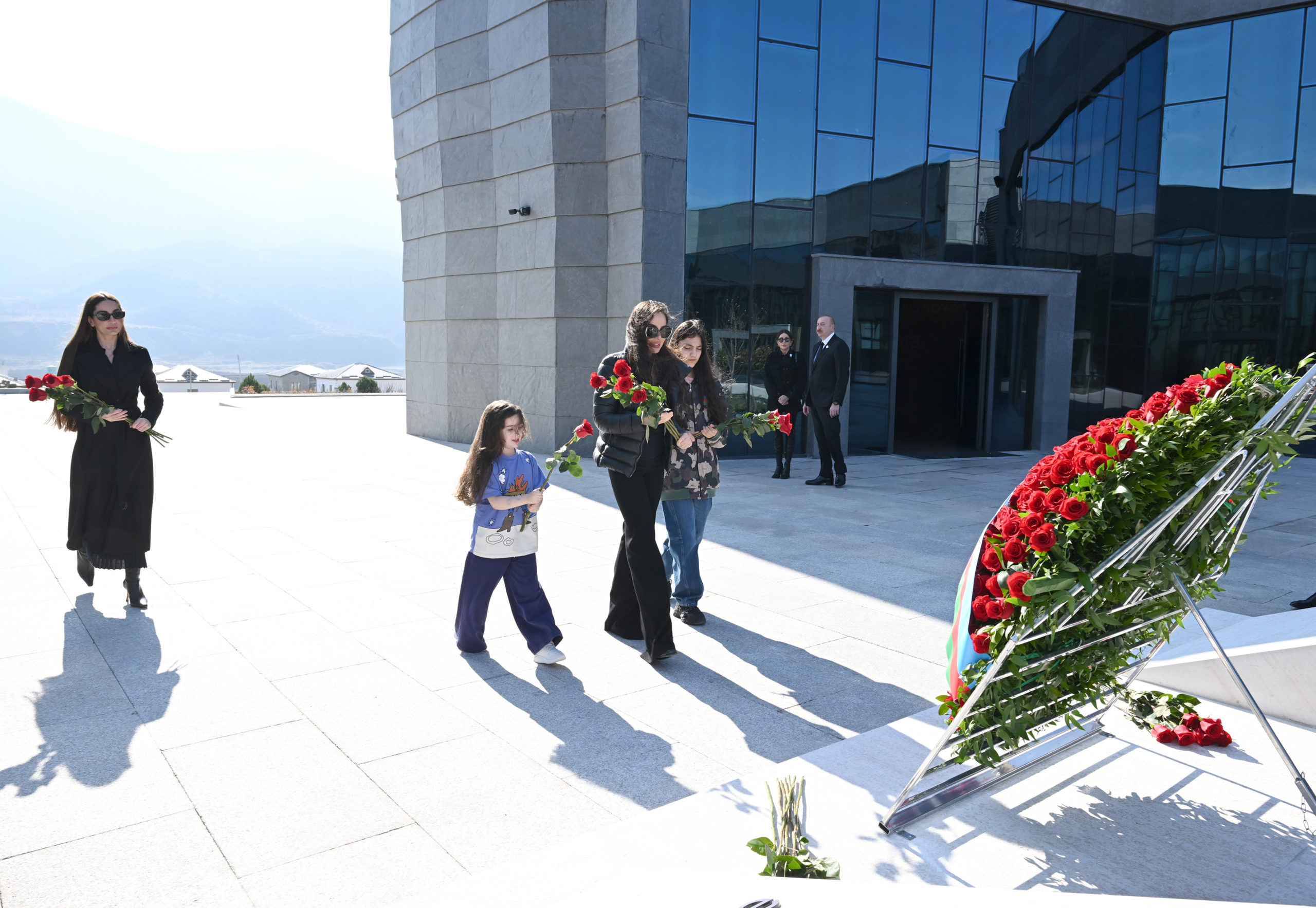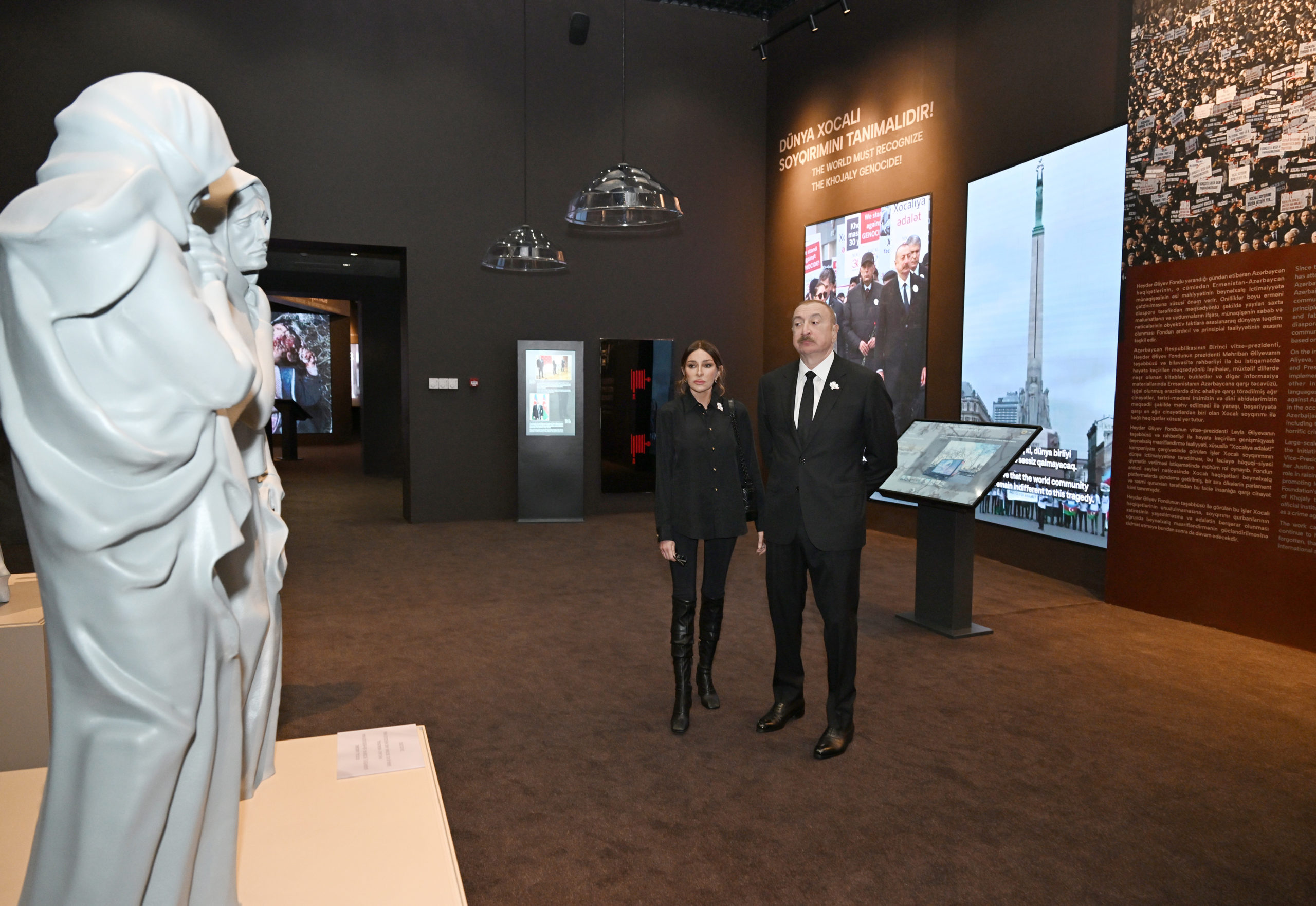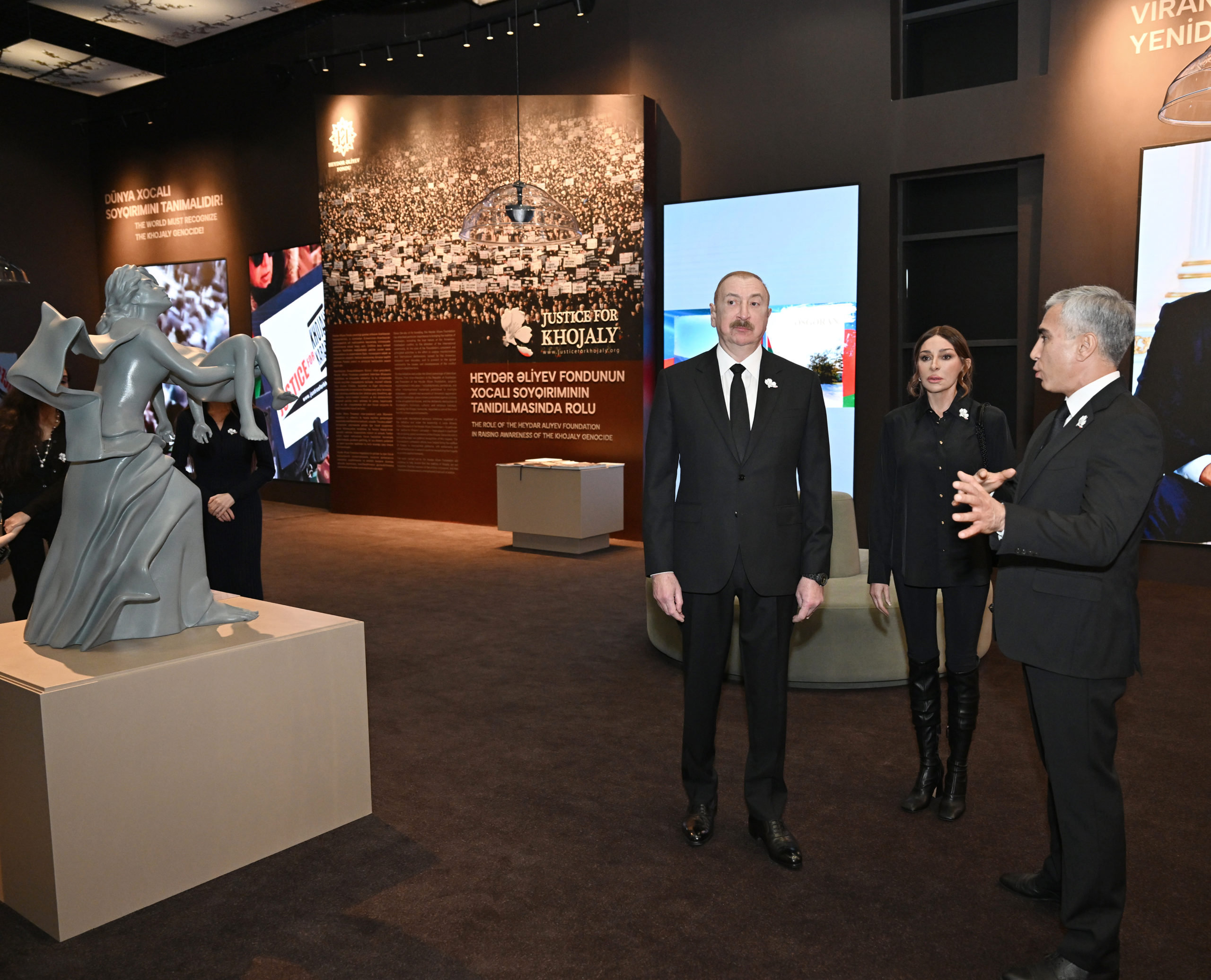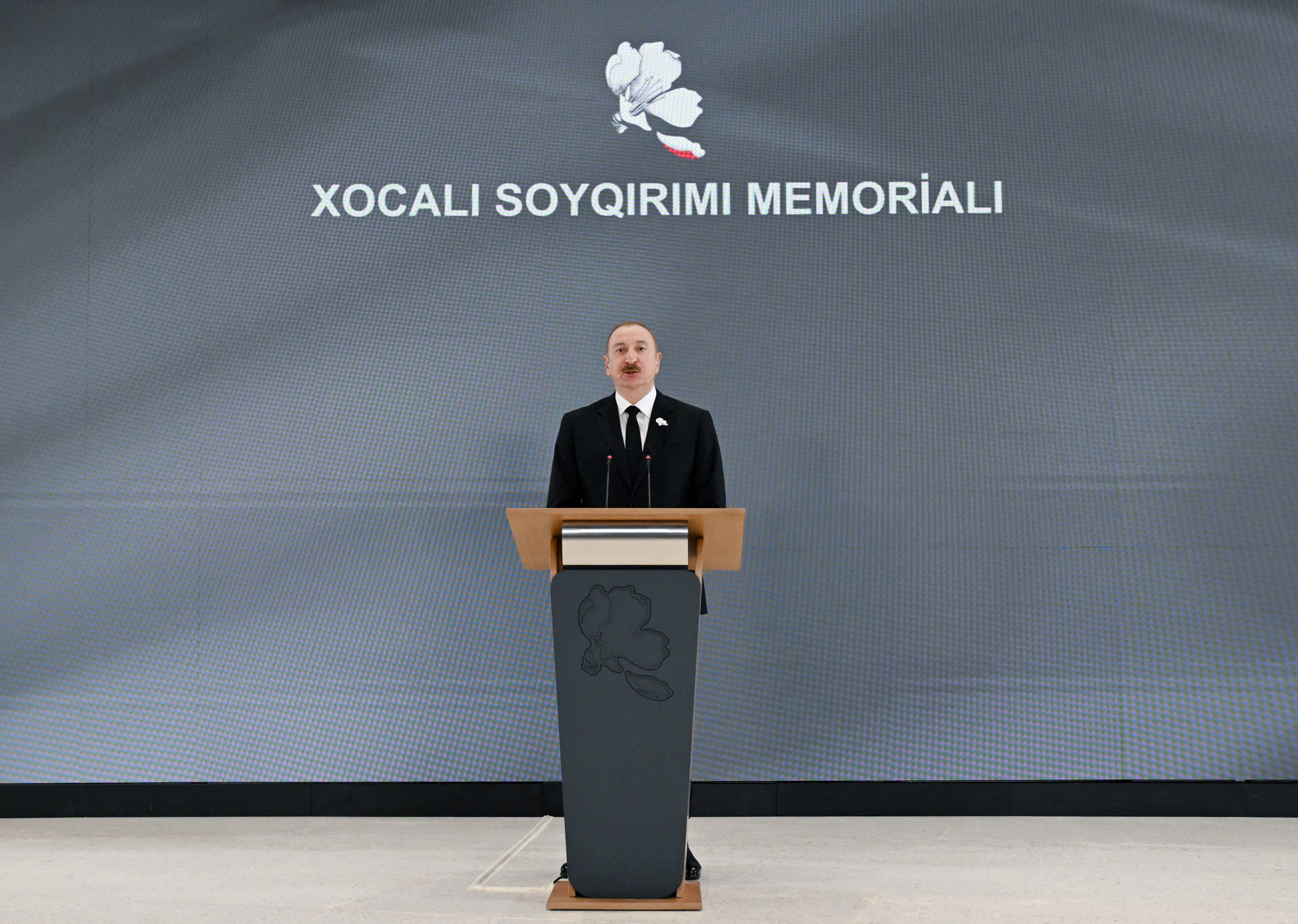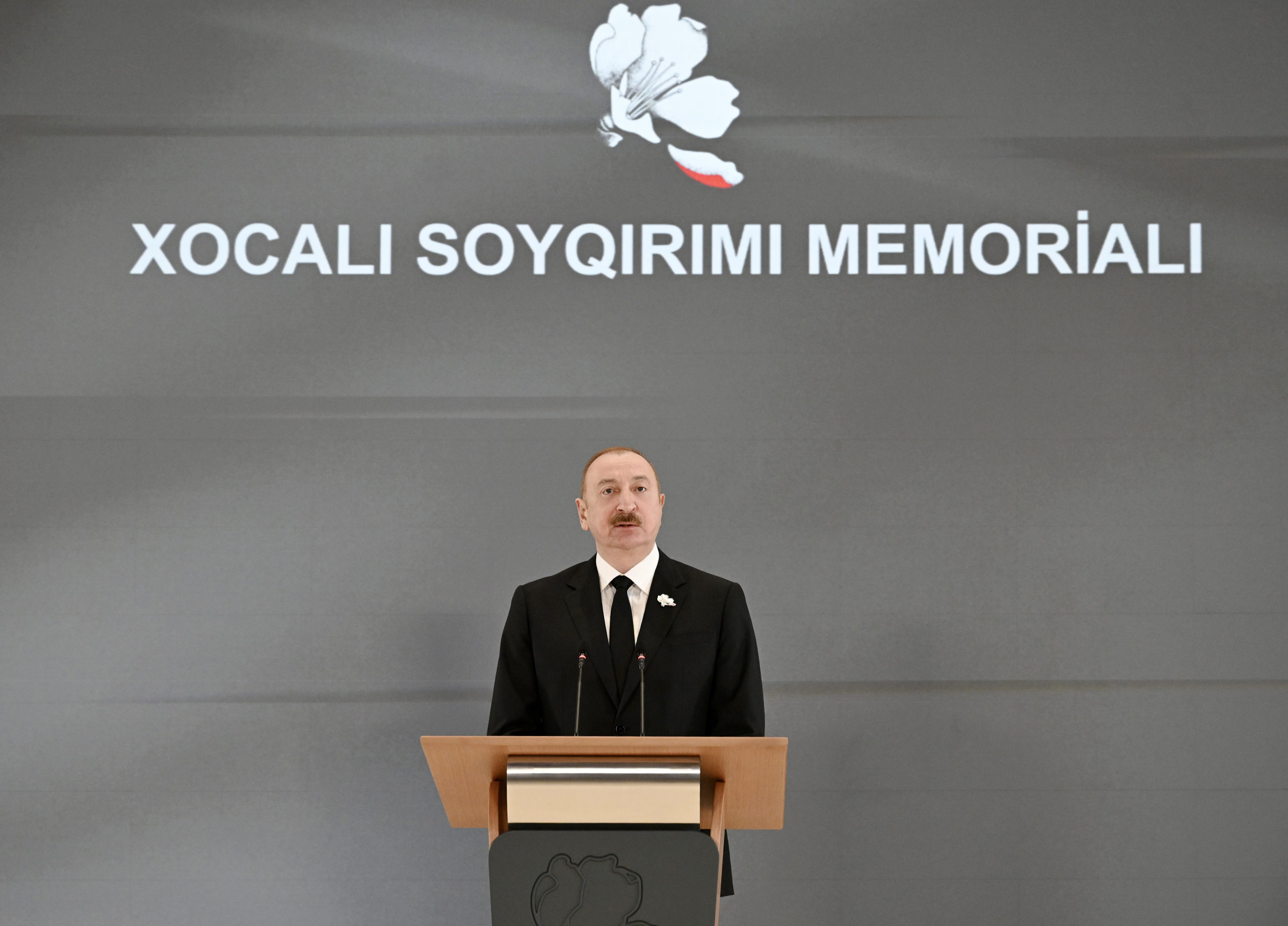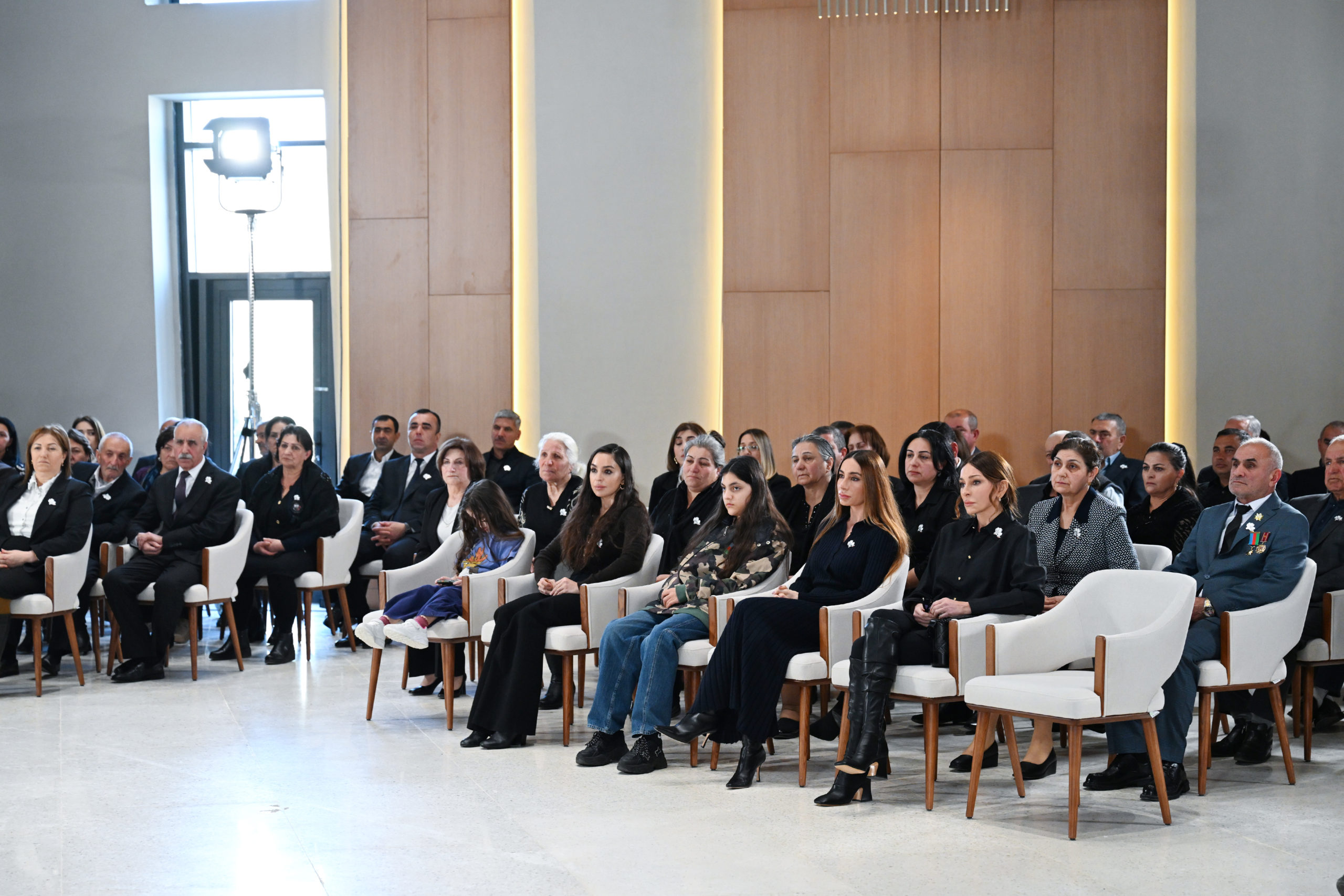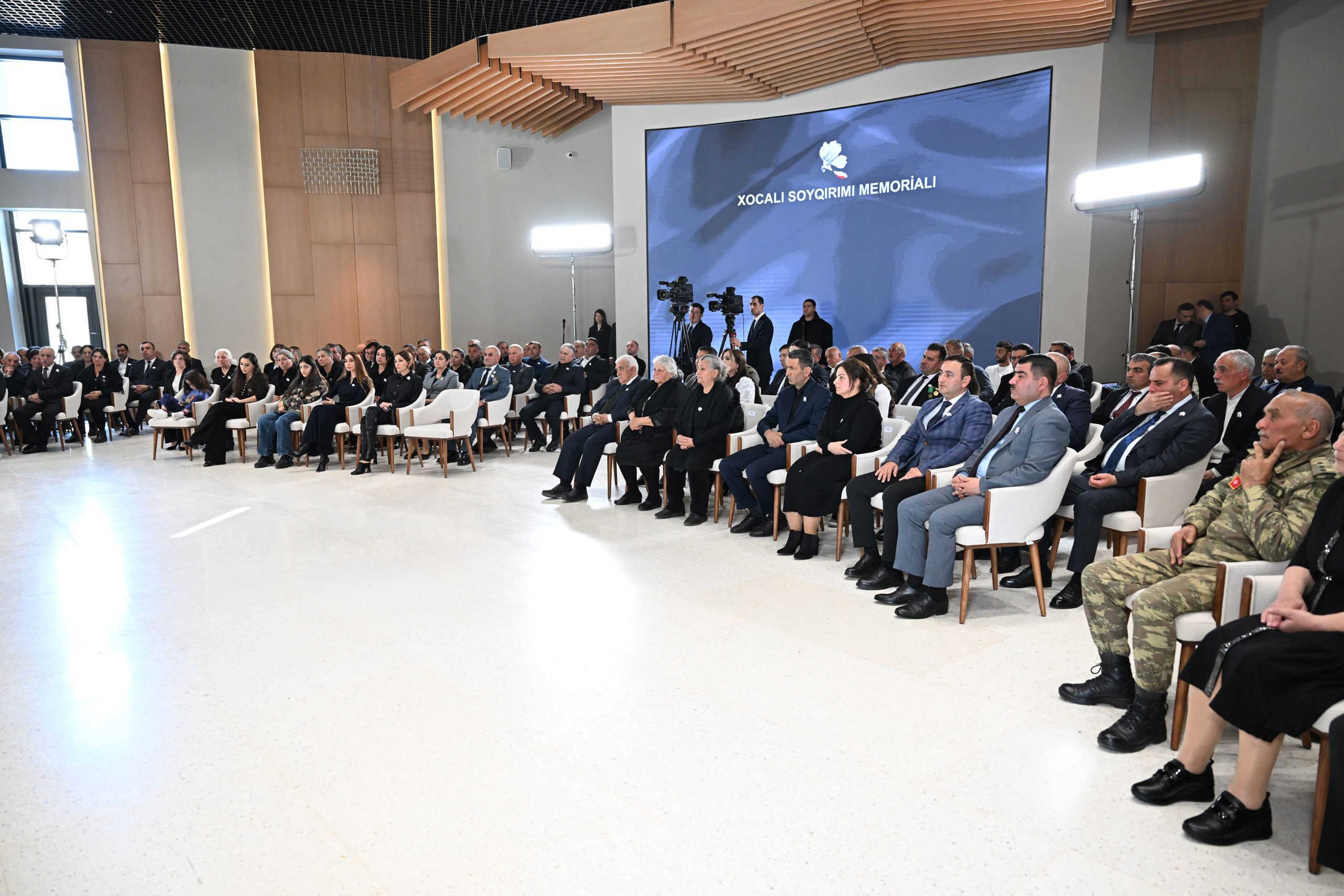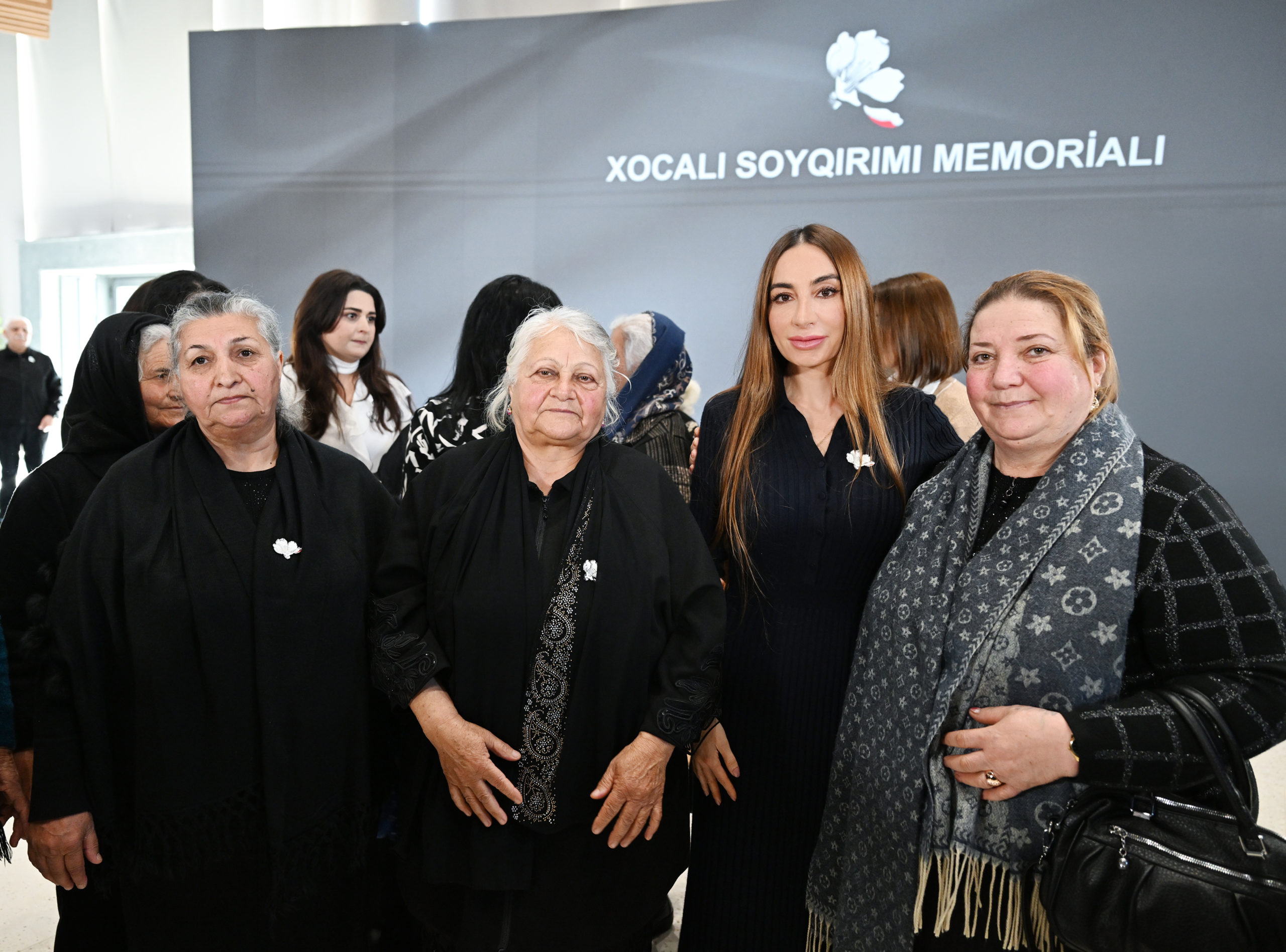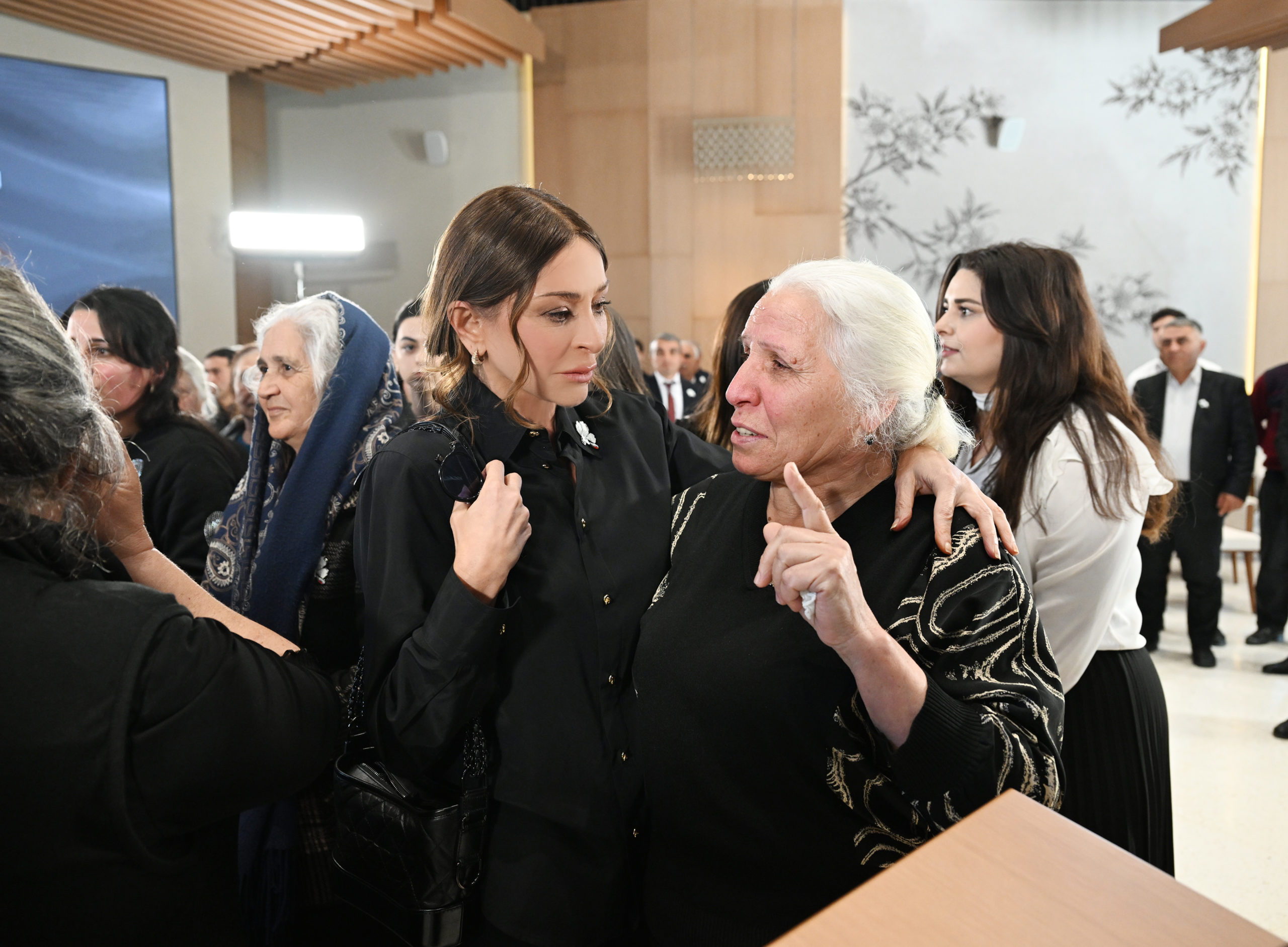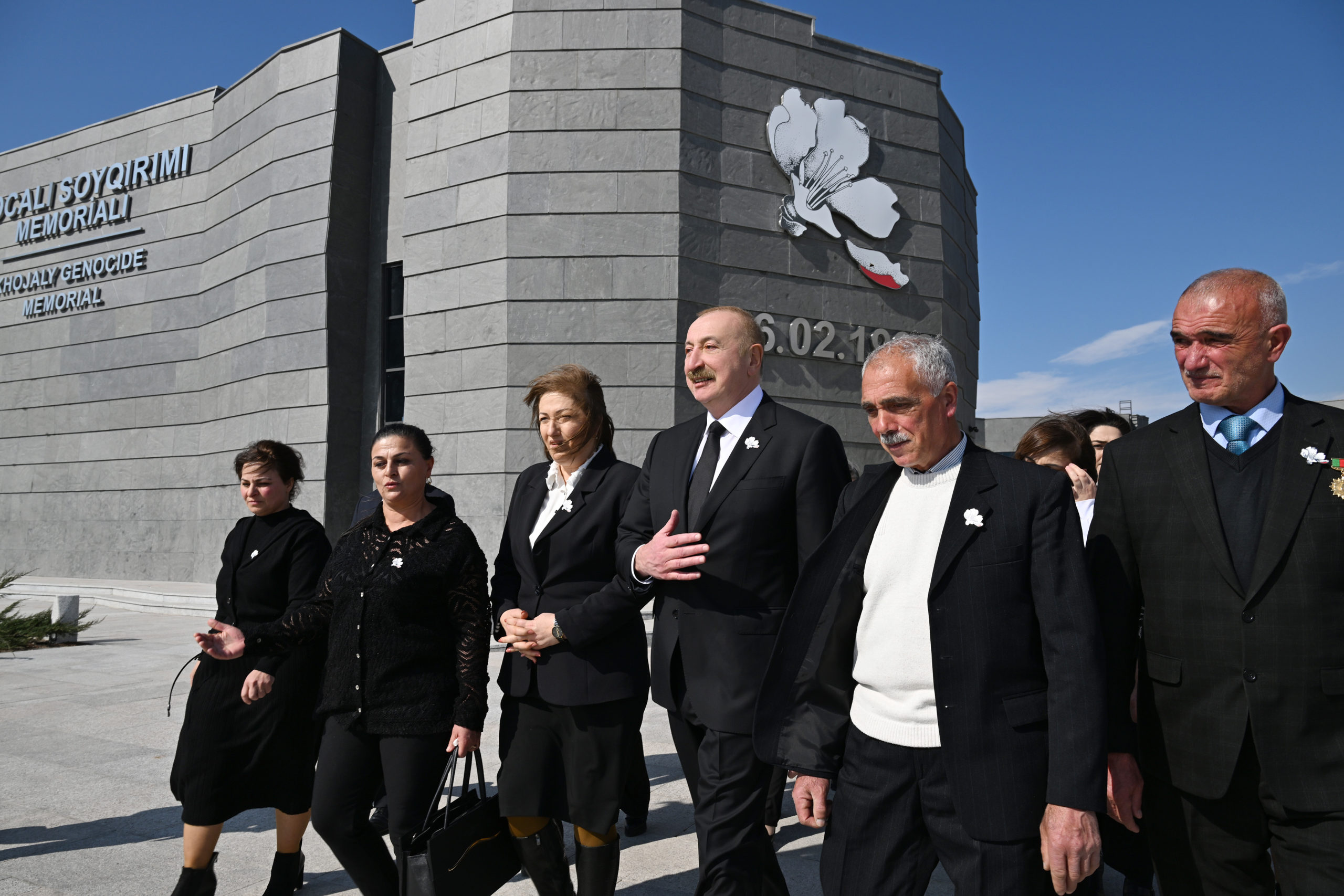


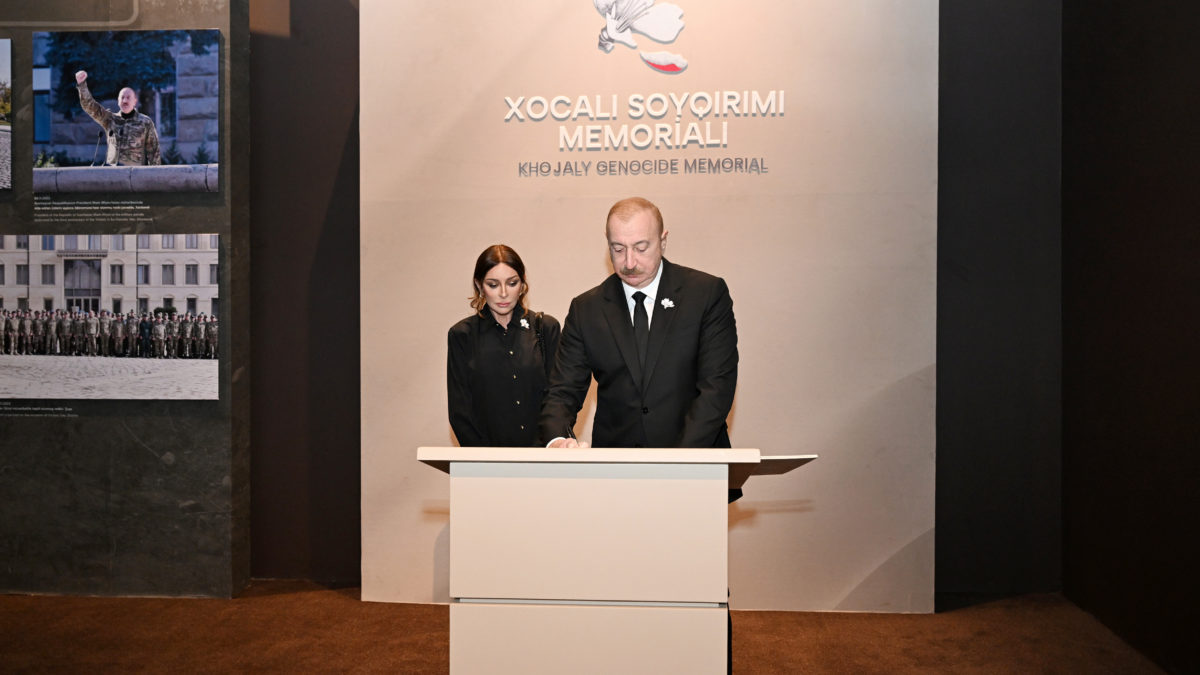
President of the Republic of Azerbaijan Ilham Aliyev, First Lady Mehriban Aliyeva, and their family members participated in the opening ceremony of the Khojaly Genocide Memorial in Khojaly town on February 26.
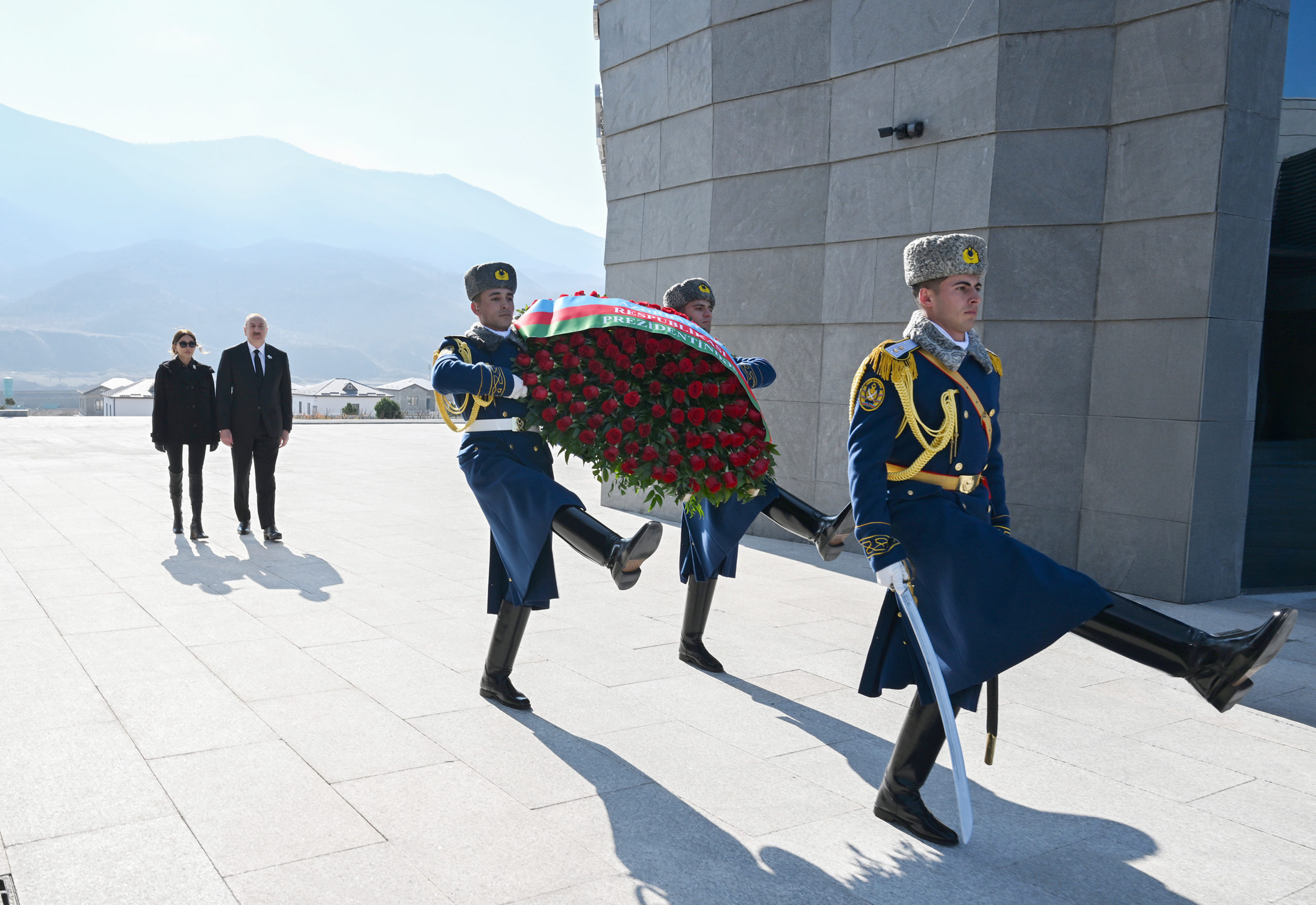
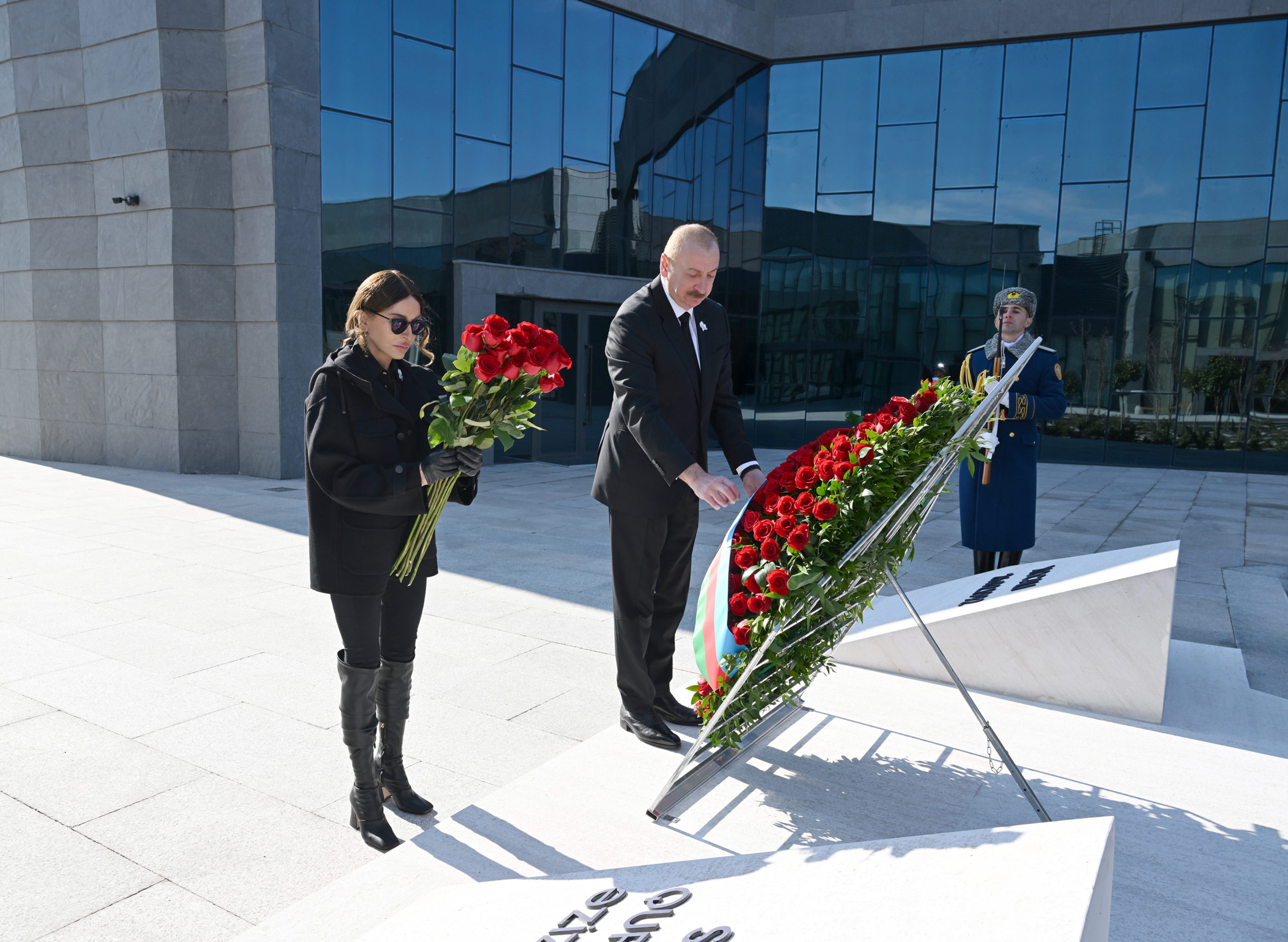
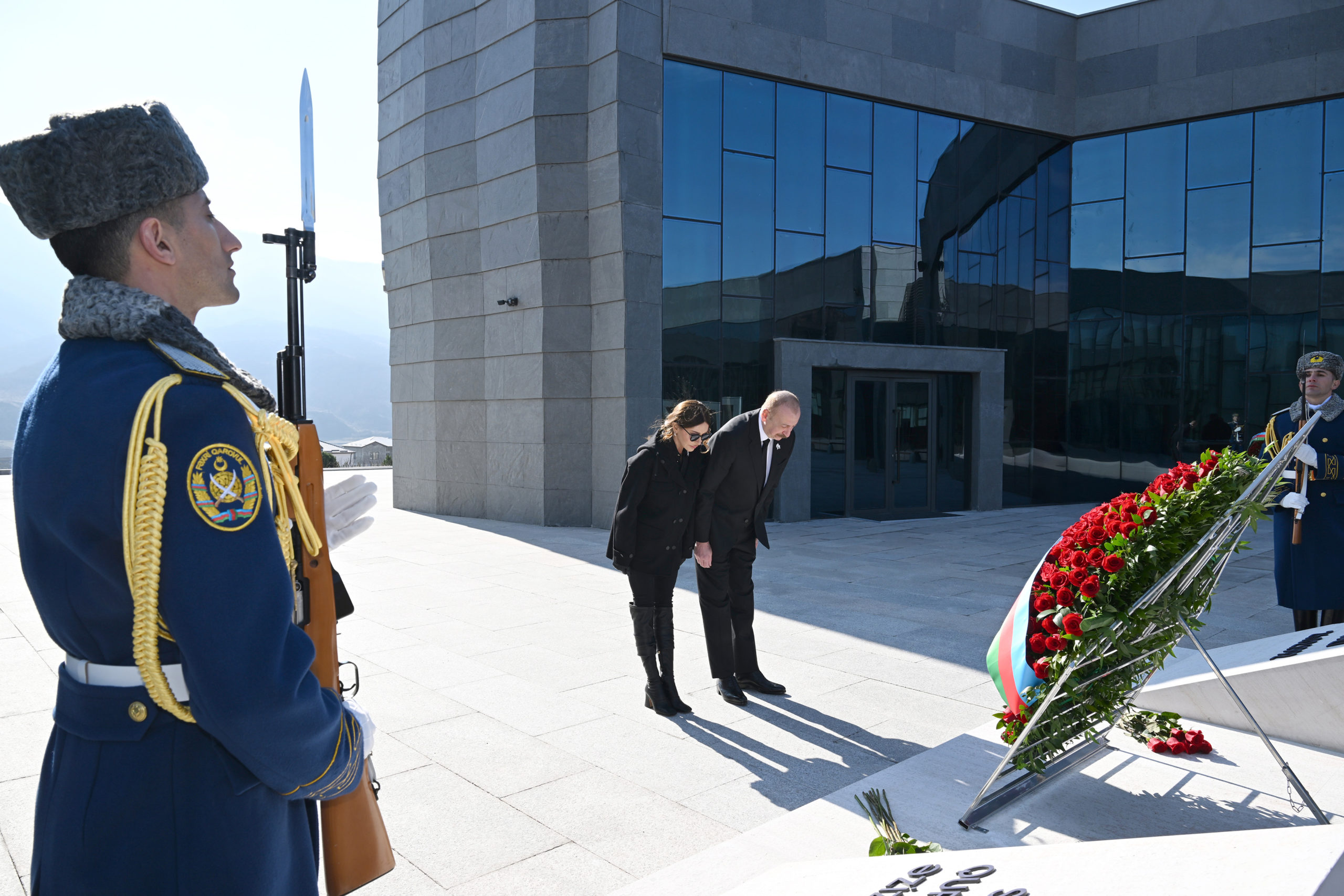
President Ilham Aliyev laid a wreath at the Memorial.
Assistant to the President Anar Alakbarov informed the head of state and the First Lady about the Memorial.
The Khojaly Genocide Memorial was established pursuant to the Order signed by President Ilham Aliyev in February 2025, with the aim of eternally commemorating the memory of the victims of the Khojaly tragedy, conveying historical truths to future generations, and preserving national memory.
The project was implemented based on the concept prepared by the Heydar Aliyev Foundation.
The monolithic structure surrounding the Memorial on four sides is designed in the form of symbolic hands protecting Khojaly residents from genocide.
As a sign of respect for the memory of the victims of the Khojaly genocide, almond trees, which bloom at the end of winter and herald spring, have been planted in the courtyard of the Memorial. Over the years, the almond blossom has been chosen as the symbol of the “Justice for Khojaly!” campaign, and this is no coincidence. The almond blossom reflects the demand for justice regarding the genocide committed in Khojaly in February 1992.
The Memorial consists of four sections. The first two sections feature an exhibition hall preserving the memory of the victims of the Khojaly genocide.
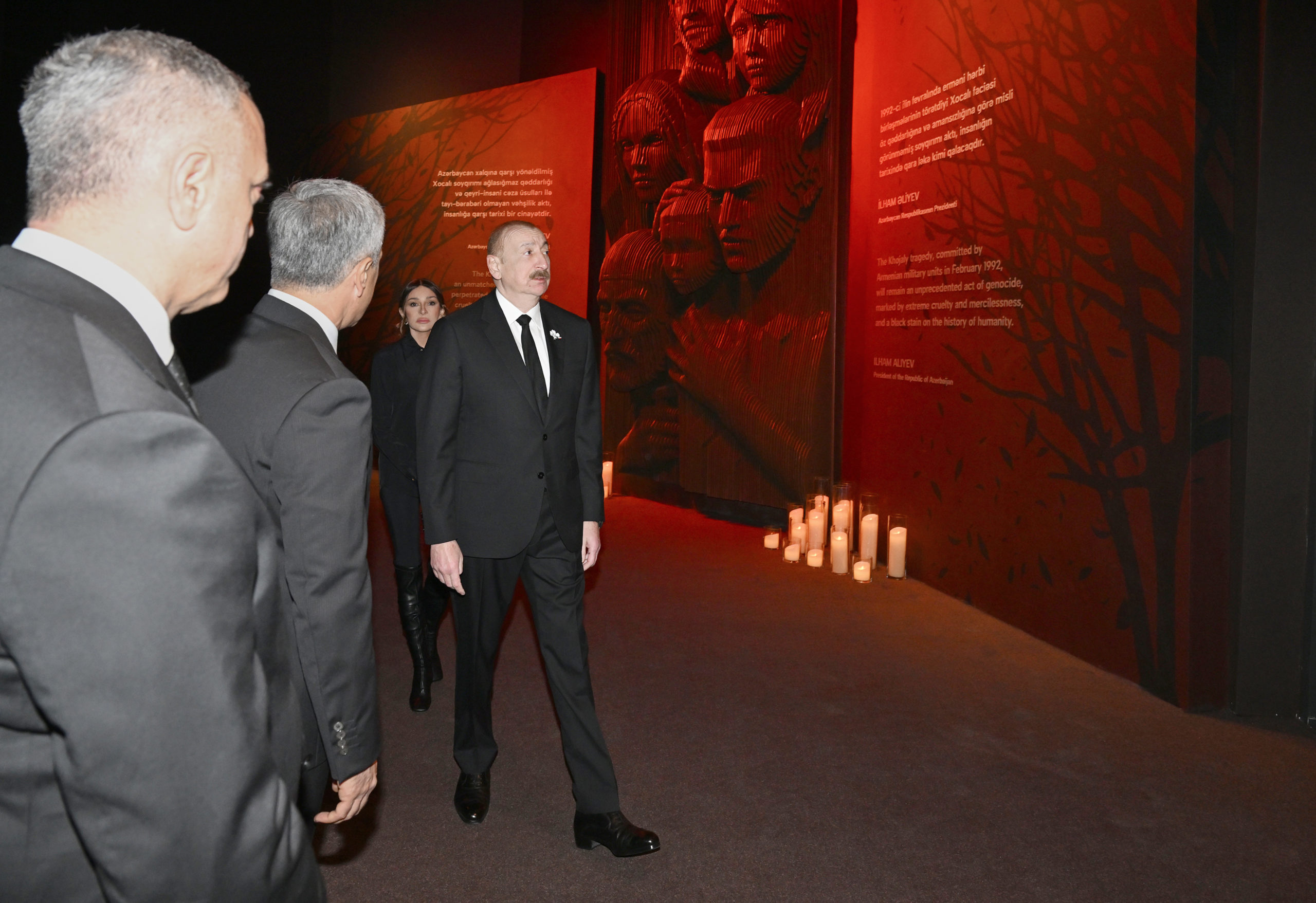
The exhibition greets visitors with the “Face of the Tragedy” installation. Authored by Rashad Alakbarov and Azer Rustamov, the installation depicts the victims of the genocide that occurred on the night of February 25-26, 1992 – innocent civilians killed and families destroyed.
Models of doves flying along the ceiling of the Memorial are a tribute to the memory of the innocent residents of Khojaly who were killed during the tragedy while wishing peace to the whole world.
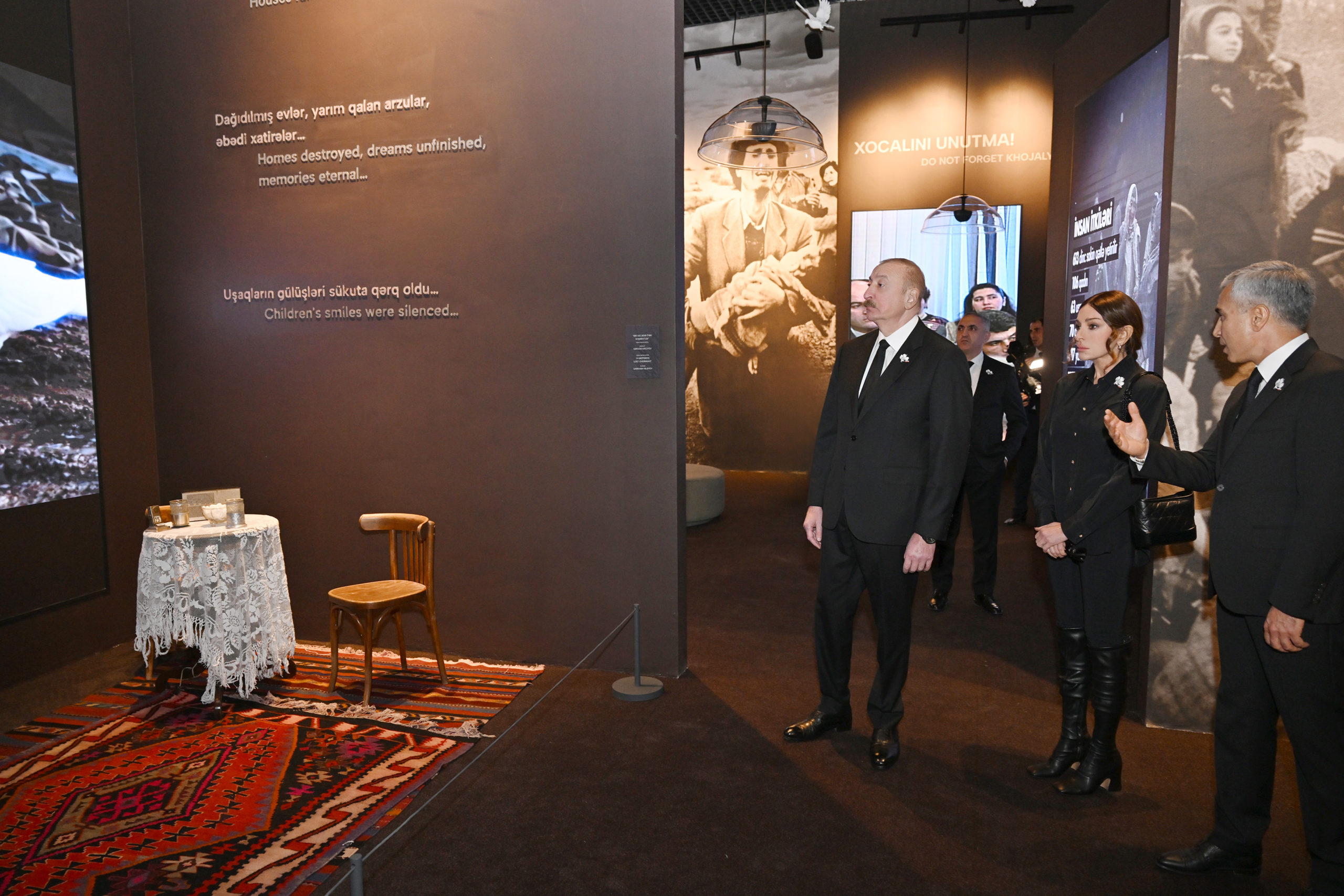
The exhibition dedicated to the Khojaly genocide – one of the most horrific crimes against humanity in the 20th century – presents the historical roots of the Armenia-Azerbaijan conflict, the policy of occupation, and the consequences of Armenian terrorism on Azerbaijani lands based on documents, maps, and facts. Exhibitions titled “Khojaly – Traces of Ancient Civilization,” “Khojaly Genocide is a Crime Against Humanity,” and “Do Not Forget Khojaly!” provide information about Khojaly’s history, the geography of the occupation, the chronology of the conflict, violations of international law norms, the Khojaly genocide as one of the bloodiest crimes against humanity, and the political and legal assessment given by National Leader Heydar Aliyev.
In the exhibition hall, information about the horrors experienced on the day of the tragedy is presented interactively via a Khojaly model.
In the second exhibition hall, Sarkhan Hajiyev’s installation “Houses Silenced in One Night” and the fates of eight families completely destroyed during the tragedy – lives interrupted in one night, unfulfilled dreams, silenced children’s laughter as a result of the crime against humanity – are presented through an AI-generated video.
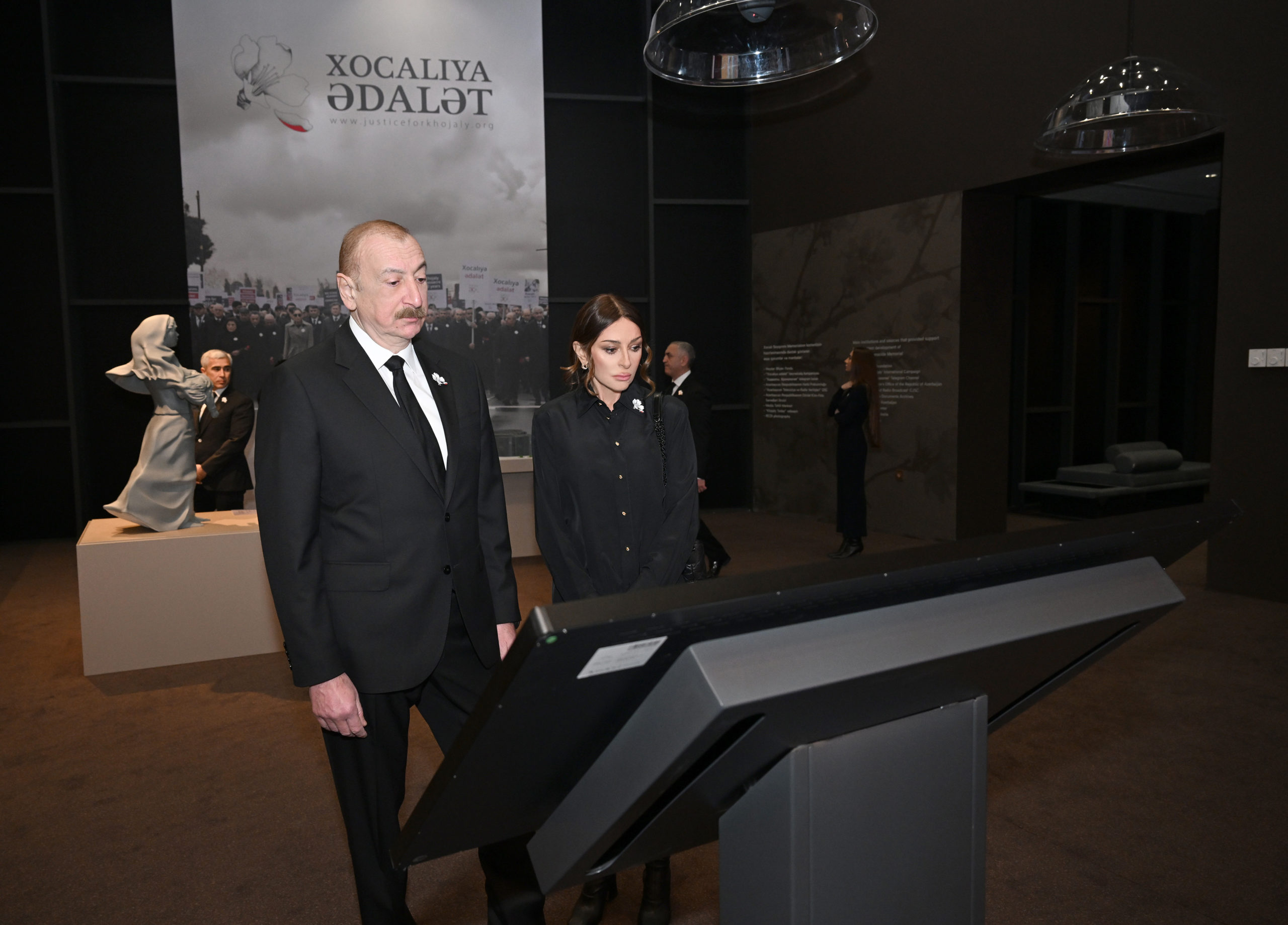
The exhibition hall reflects President Ilham Aliyev’s consistent policy to promote Khojaly truths at the international level, the activities of the Heydar Aliyev Foundation under the initiative and leadership of its President Mehriban Aliyeva to preserve the memory of Khojaly genocide victims and establish justice, publications and informational materials in various languages, as well as the work carried out within the framework of the international “Justice for Khojaly!” campaign initiated by Vice President of the Heydar Aliyev Foundation Leyla Aliyeva and her active participation in related events.
Models of monuments erected in several countries in memory of the genocide victims within the “Justice for Khojaly!” international campaign are also displayed here.
The exhibition concludes with information on the 44-day Patriotic War and the restoration of state sovereignty, embodying the ideas of the “Great Return” and “Devastated Khojaly will revive again.”
Another section of the Memorial features an assembly hall intended for official events and commemoration ceremonies.
The Khojaly Genocide Memorial serves as a space dedicated to preserving national memory in architectural and conceptual terms.
On the night of February 25-26, 1992, Armenian military units, with the participation of the 366th motorized rifle regiment of the former Soviet army stationed in Khankendi, committed a horrific genocide in Khojaly. During the tragedy, 613 people were killed. Among them were 63 children, 106 women, and 70 elderly people. As a result of the military aggression, 8 families were completely wiped out, 25 children lost both parents, and 132 children lost one parent.
The Memorial erected in liberated Khojaly will eternally preserve the memory of the genocide victims and convey historical truths to every visitor.
Today, the Azerbaijani people commemorate the memory of the victims of the Khojaly genocide, one of the most horrific massacres of the 20th century, as a victorious country and a victorious people. The souls of the Khojaly victims are at peace today. As the Victorious Supreme Commander-in-Chief said, their blood was not shed in vain; their revenge was taken on the battlefield during the Patriotic War.
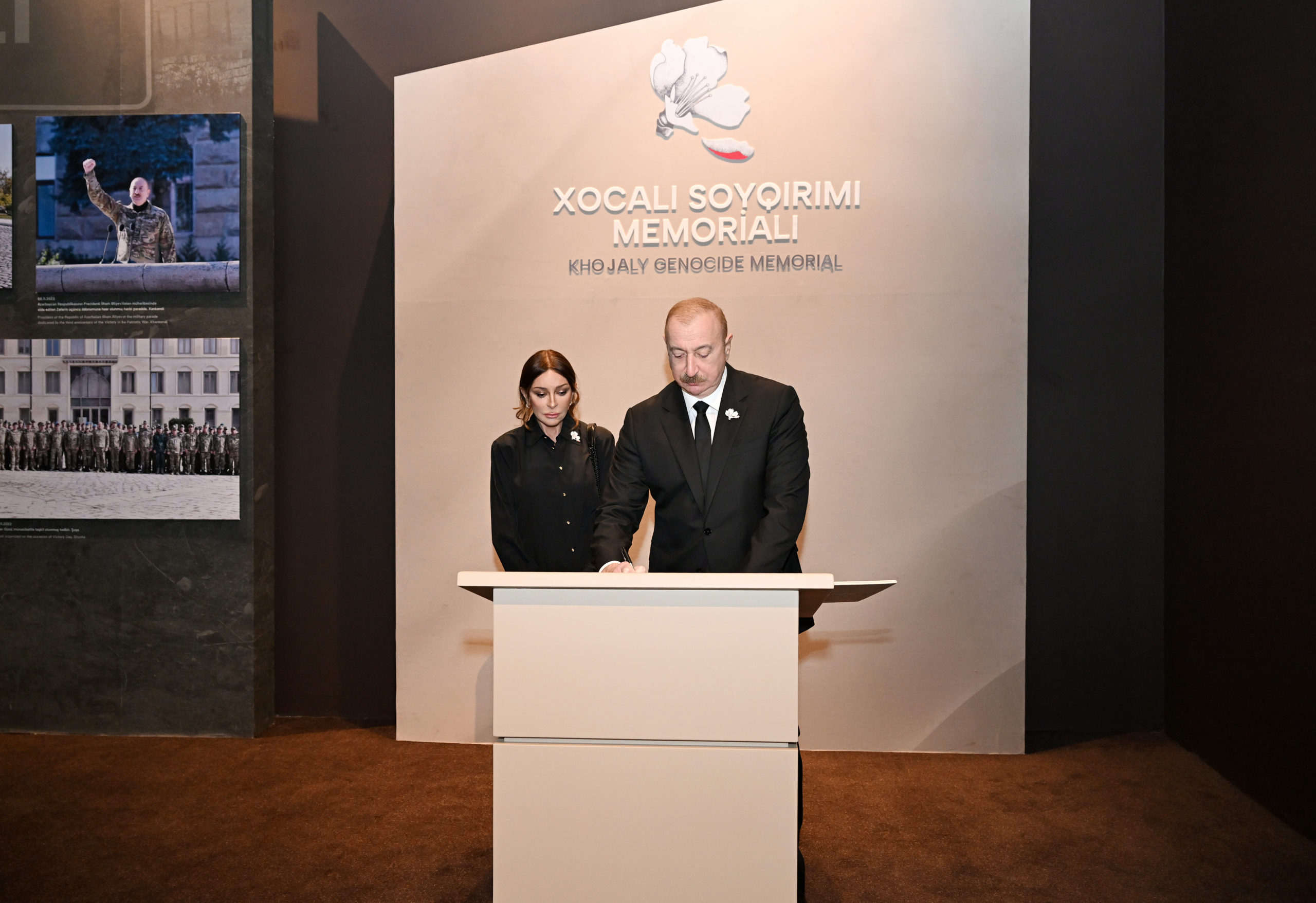
President Ilham Aliyev then signed the Memorial’s guest book.
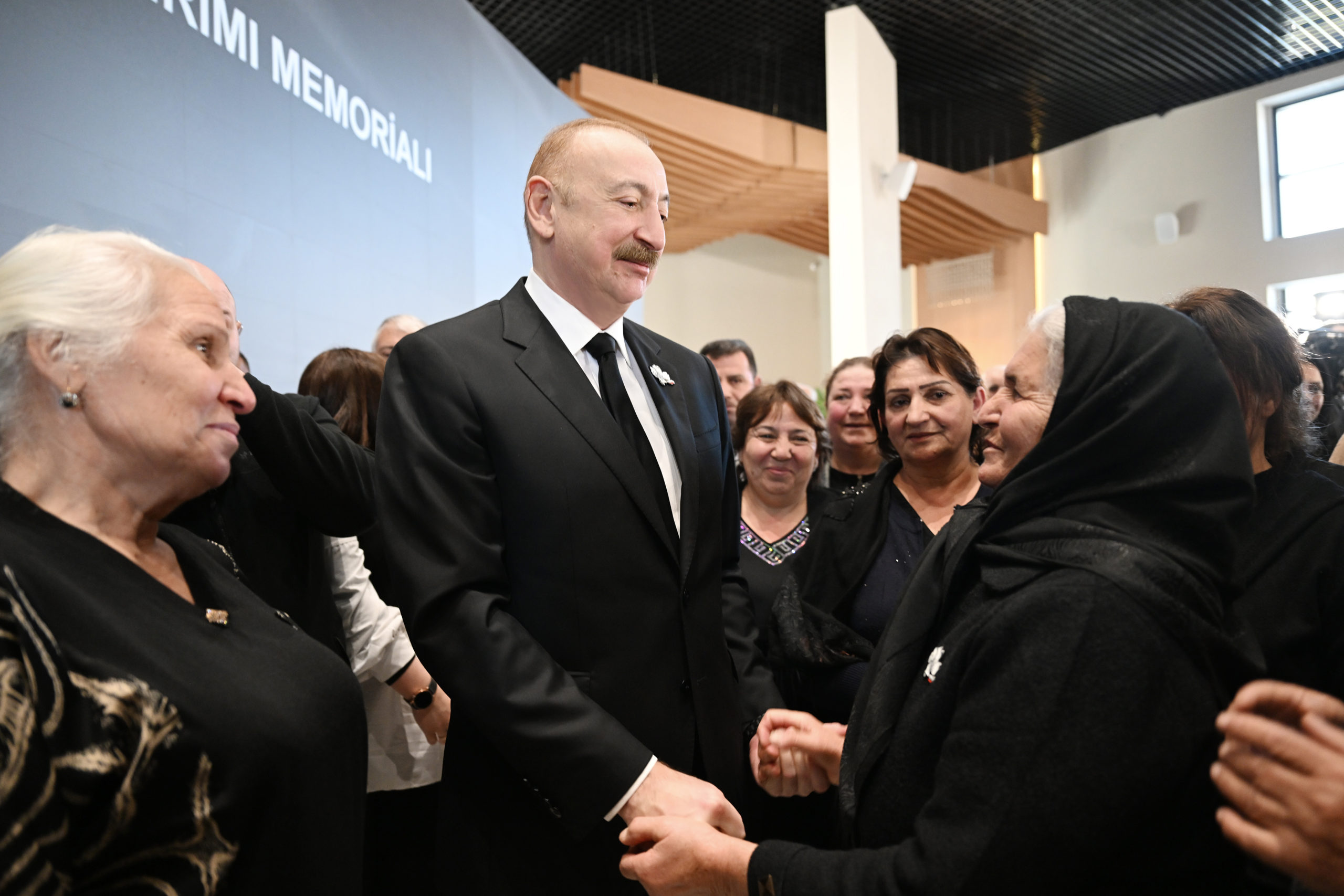
Afterward, the head of state, the First Lady, and their family members toured the Memorial and met with representatives of the Khojaly district community.
The head of state delivered a speech at the meeting.
Speech by President Ilham Aliyev
– Two years ago, the foundation of the Khojaly Genocide Memorial Complex was laid with my participation. Today, we are gathered for the opening of this Memorial Complex.
The Khojaly genocide is a bloody war crime committed by the Armenian state against Azerbaijanis — a crime against humanity. The Armenian state bears full responsibility for this act. In a single night, more than 600 innocent civilians were brutally killed, including 106 women and 63 children. One hundred fifty people went missing, and it is believed that they were also killed. The remains of some victims were found after the occupation and subsequently buried.
This is the greatest tragedy for the Azerbaijani people. In order to convey this tragedy to the world and to present our just cause to the international community, the government of Azerbaijan, public organizations, NGOs, and many institutions have been working hard. I would like to specifically mention the activities of the Heydar Aliyev Foundation here today. Immediately after its establishment, the Foundation launched a large-scale campaign, “Justice for Khojaly!” This initiative was implemented by the Vice-President of the Foundation, Leyla Aliyeva.
Over the past 20 years, numerous events, presentations, symposiums, and conferences have been organized in many countries around the world at its initiative. Many books, brochures, and booklets have been published.
Because the Armenian state and Armenian communities worldwide, as well as their backers, attempted to conceal this tragedy, Armenian propagandists also sought to shift the blame onto Azerbaijan. Had we not raised our rightful voice, there might be no accurate information about the Khojaly genocide in the world today. It is precisely as a result of our persistent efforts that approximately 20 countries have officially recognized the Khojaly genocide as an act of genocide, and this process continues.
The impact of the “Justice for Khojaly!” campaign has been significant. Let me reiterate that we demanded justice. Unfortunately, international organizations and leading countries around the world remained indifferent to our tragedy. I would like to state again that there were attempts to conceal this crime perpetrated by the Armenian state. Nevertheless, we moved toward justice step by step.
The official recognition of the Khojaly genocide by approximately 20 countries was one step; the Patriotic War and our victory were the second step; and the liberation of the city of Khojaly two and a half years ago was another step. Most recently, the trial of war criminals in Baku marked the final step. The henchmen who committed the Khojaly genocide and whose hands were stained with the blood of the Azerbaijani people had to be held accountable in court.
As a result of the Second Patriotic War and the anti-terrorist operation, some war criminals were eliminated by the Armed Forces of Azerbaijan, while others – especially those considered leaders of the separatists – were detained at different times and brought to justice. This represents a complete triumph of justice. We secured justice ourselves; our people, united like a fist, demonstrated tremendous heroism in both 2020 and 2023. Justice was achieved through the professionalism, dedication, and courage of our Armed Forces. Bringing war criminals to account and conducting a fair trial, I emphasize, was the final manifestation of justice.
There are few countries in the world that could achieve a complete and absolute victory in a just war, secure their territorial integrity and sovereignty by liberating every inch of their land, and then bring war criminals to justice. We did this—the state of Azerbaijan did. Our determination and unbending resolve made it possible. The people of Azerbaijan know all too well the pressure and threats we faced during the occupation.
During the occupation, we were often told to accept the reality that Azerbaijan would not be able to liberate its lands, that the great powers—the patrons of Armenia—would not allow it, and that the Azerbaijani Army could not prevail on the battlefield. Such far-fetched speculation was widely circulated in the media and conveyed to Azerbaijan’s leadership through various channels. But no force could sway our determination, and we stated this repeatedly
At that time, I stated—both from authoritative international platforms and during numerous meetings with the then-displaced persons—that we would not tolerate the occupation, and that if the issue could not be resolved through negotiations, we would restore our territorial integrity by military means—and that is exactly what happened.
After I was elected President for the first time, I stated in my swearing-in speech that this was a key issue for us and that our territorial integrity must be fully restored. The period of preparation took time, and this was only natural. We needed to gather strength and grow stronger. We also had to affirm our rightful cause at the international level, including conveying information about the war crimes of the Armenian state.
We had to convey the truth about the Khojaly genocide—and we did. In recent years, many international organizations were compelled to adopt decisions and resolutions in support of our just position. This helped establish the legal framework for resolving the Armenia-Azerbaijan conflict. We have built close bilateral relations with the number of countries and strategic partnerships with many others. This has created an opportunity to communicate the realities of Azerbaijan and the Nagorno-Karabakh conflict at the international level.
We have built a strong, independent economy. We have also built a strong army—enhancing its professionalism while procuring weapons, ammunition, and equipment with the revenues we generated. In other words, day by day, month by month, we moved toward Victory. I stated this many times during the occupation: every day, we had to bring Victory closer—and we did.
In just 44 days, we defeated the enemy—the enemy surrendered, signed the act of capitulation, and the war came to an end. Today, the history of the past two and a half years shows how correct and well-considered this strategy was. It is true that Khojaly, Khankendi, and some other settlements had not yet been liberated at the time, but I knew—and I am certain that the people of Azerbaijan also knew—that this day was not far off.
As a result of the anti-terrorist operation that lasted only a few hours in 2023, the illegal junta was eliminated, the occupiers were expelled from our lands, and the 15,000-strong Armenian army, illegally stationed on our territory, was disarmed and surrendered. This was the final nail in the coffin of Armenian separatism. It was at that moment that justice for Khojaly was secured.
Today, the opening of this Memorial Complex in Khojaly is a celebration of justice. I said this two years ago at the groundbreaking ceremony, together with the people of Khojaly, when we laid the foundation of this complex. At that time, I noted that the project had been prepared by the Heydar Aliyev Foundation and was ready for a long time—it had been planned exactly as it is now, a location had even been chosen in Baku, and only a final decision on my part was needed to launch construction. Yet, each time, something held me back. Then I understood what it was: the belief that the day would come when we would build this Memorial Complex in Khojaly itself—and so we did.
This Memorial Complex will be the embodiment of an indelible memory. We must never forget the Khojaly genocide. We must never forget the atrocities committed by the Armenian state. We must never forget our history. We must remain vigilant, and we must always be strong. The enemy must always fear us, just as they do today. It is because of this fear that the people of Azerbaijan live in peace today.
Unfortunately, the Patriotic War did not teach the Armenian state a lesson. After the Victory of 2020, we repeatedly conveyed our position to the Armenian leadership in various ways—not to trust anyone or rely on anyone. Foreign military personnel were temporarily stationed on our land with our permission. Anyone who thought this would somehow deter us was obviously mistaken. We repeatedly sent messages to the Armenian side, urging them to end separatism, dismantle the illegal junta regime, and encourage Armenians living in Nagorno-Karabakh to become Azerbaijani citizens.
We had stated this repeatedly. We even initiated an online reintegration program but received no adequate response. On the contrary, the separatists and the forces behind them became even more brazen. From the Victory of 2020 until the anti-terrorist operation of 2023, representatives of foreign states repeatedly entered our territory illegally. I do not wish to mention the names of those countries at today’s ceremony. They offered advice, sent weapons, and even supplied mines to encourage the separatists, incite them against us, and disregard the state of Azerbaijan and its sovereignty. They believed that the presence of foreign contingents here would somehow deter us. It could not deter us from anything, and the anti-terrorist operation, which lasted only a few hours, demonstrated this to the entire world. Anyone who stands in the way of our determination will be crushed.
Residents of Khojaly are attending the opening of this Memorial Complex today. Almost every one of them has lost loved ones, family members, or relatives and has carried this pain and sorrow for many years. Those who lost their loved ones, and those who lost their land and were displaced from their homeland, must have had tremendous willpower to endure all of this – and they truly did. What sustained them was faith: faith in justice, faith in the state, and faith in our army.
Today, this Memorial Complex stands as an embodiment of the unbending spirit of the Azerbaijani people. For so long—the Khojaly genocide being one of the bloodiest crimes of the 20th century, and our people having suffered greatly—our nation preserved its identity, dignity, and faith despite facing injustice for 30 years. As we gather for the opening of this Memorial Complex, we reaffirm that the state of Azerbaijan is so strong today that no one should even think of committing any provocation against us.
Azerbaijan is no longer what it was in 1992. Today, our state is strong and fully capable of defending itself. In the past 80 years, no other country in the world has achieved such a complete and absolute victory as we did. Today, we live in peace, and the guarantor of this peace is the state of Azerbaijan and our policies.
During the Patriotic War, when our cities and villages were being bombed by the Armenian state, I said that we are Azerbaijanis and that we wage—and will continue to wage—war according to the rules of war. Unlike the Armenians, we never targeted innocent and unarmed civilians, and this has made our people even greater. Today, respect for our people and our state stems, among other things, from this. At that time, I said we would exact our revenge on the battlefield—and we did. The blood of all our martyrs has been avenged, and this brings at least some consolation to their relatives and loved ones. May Allah rest the souls of all our martyrs in peace! We will cherish their memory in our hearts forever. We will never forget the Khojaly genocide or the other war crimes committed against us by the Armenian state. We must—and we will—always be strong so that such tragedies never happen again.
x x x
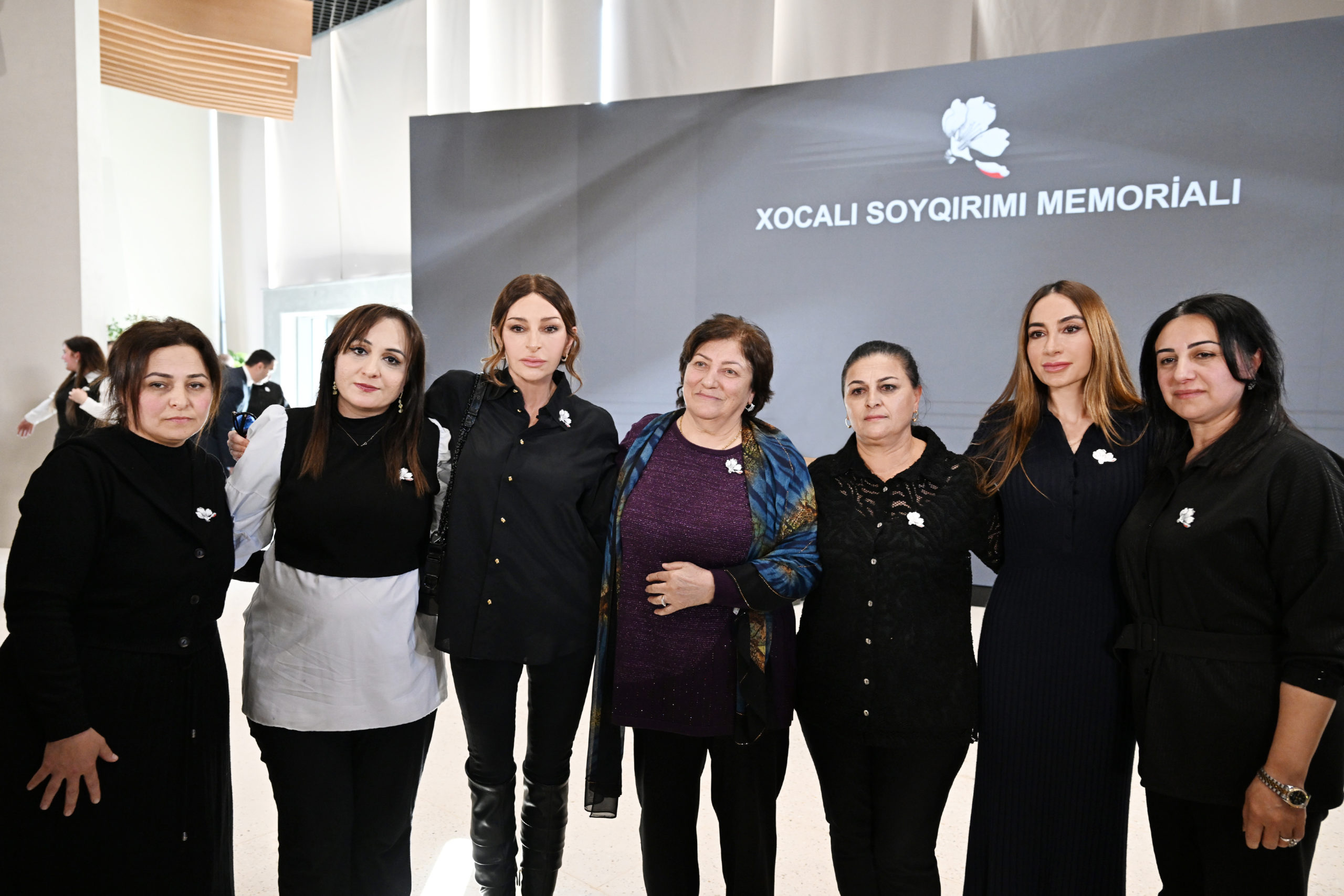
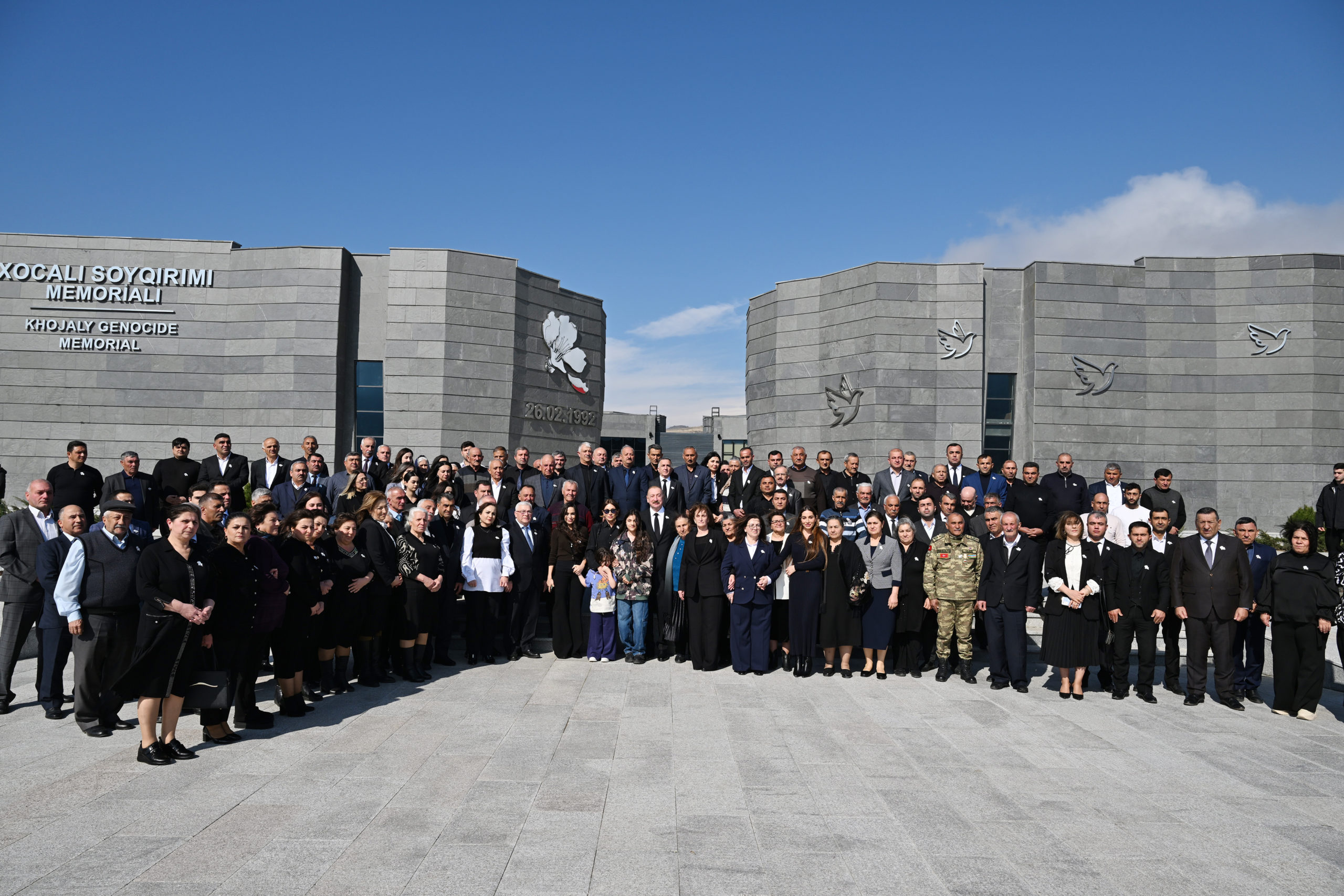
The event concluded with commemorative photos.
https://president.az/en/articles/view/71709